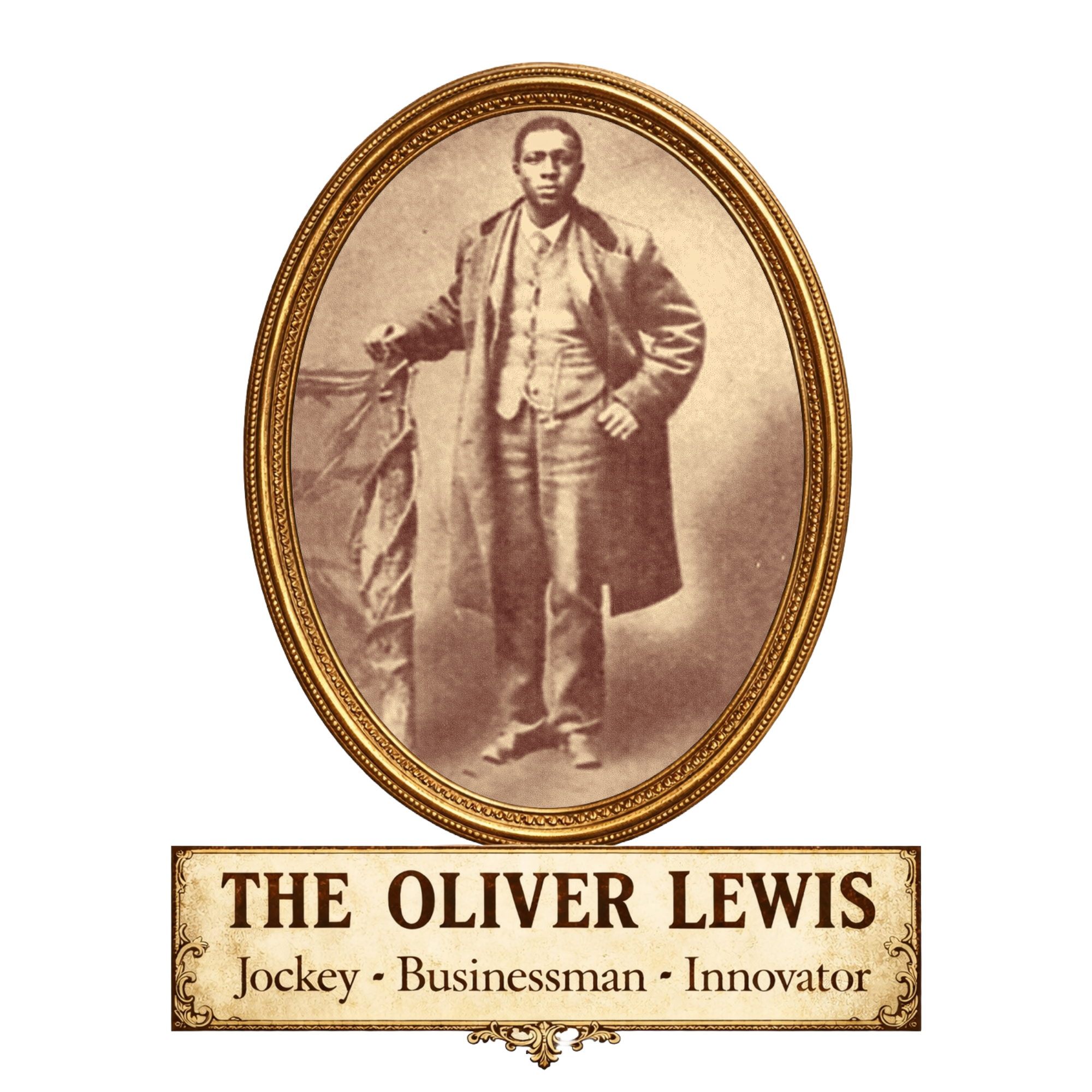
Oliver Lewis: Beyond the Finish Line
A long historical narrative
Early Life
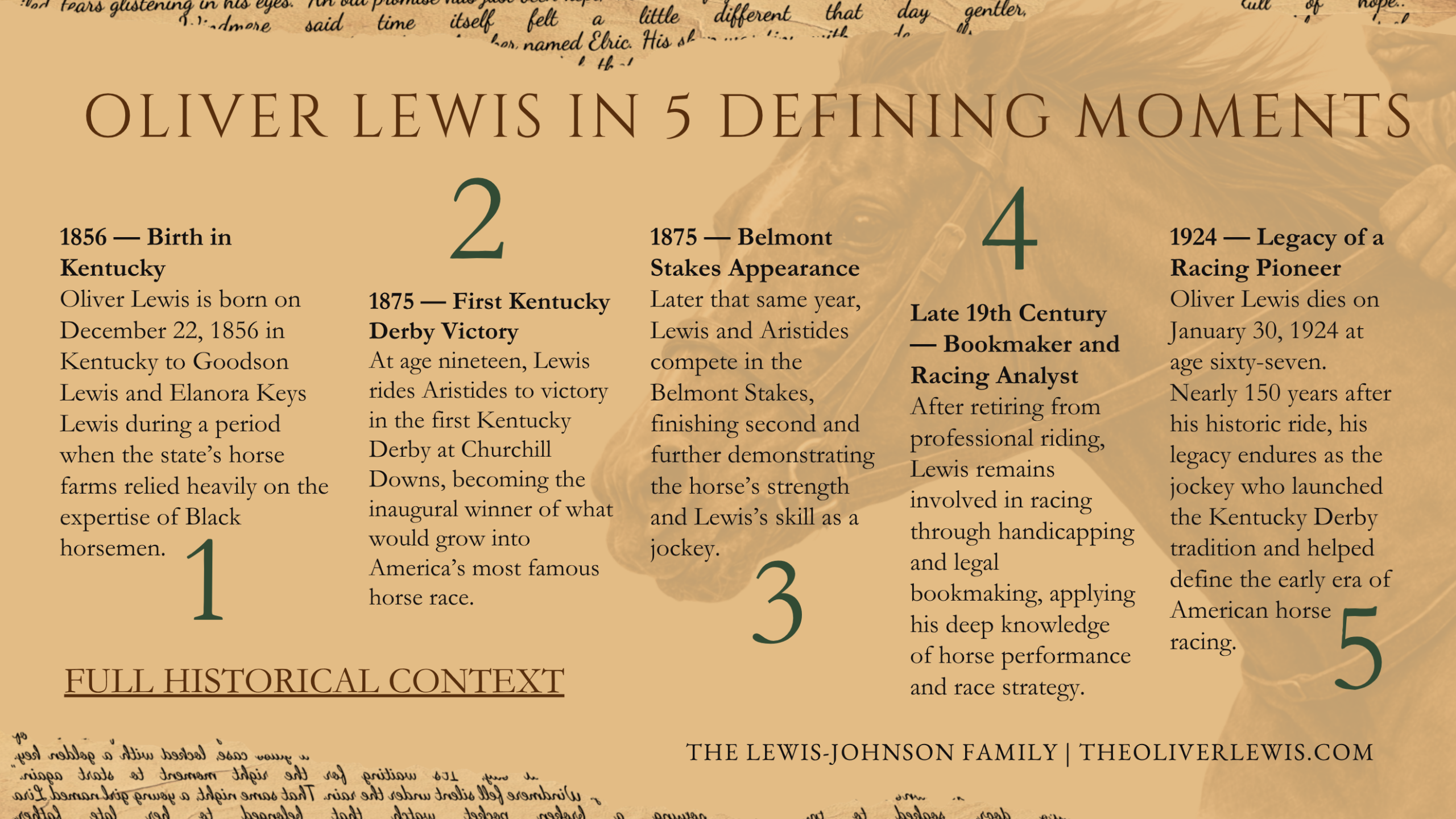
In the mid-nineteenth century, in a Kentucky landscape shaped by horse farms, tobacco fields, and the deep inequalities of slavery, a boy named Oliver Lewis was born into a world that would soon be changing rapidly. Like many African Americans born in Kentucky before the Civil War, Lewis entered life during a period when Black families were legally enslaved and their lives tightly bound to the agricultural economy of the region. Kentucky was not part of the Confederacy, but slavery remained legal in the state until the end of the Civil War, and thousands of enslaved men, women, and children lived and labored throughout the Bluegrass region.
Precise records of Lewis’s birth and family lineage remain limited, as was often the case for African Americans born into enslavement. Birth certificates were rarely recorded for enslaved individuals, and family histories were often preserved only through oral traditions. What historians generally agree upon is that Oliver Lewis was born in Kentucky sometime in the 1850s and likely spent his earliest years working in environments closely tied to horse breeding and training.
Kentucky’s horse culture had already begun to take shape by the mid-1800s. The state’s rich soil, temperate climate, and wide pasturelands made it one of the most important centers for Thoroughbred breeding in the United States. Enslaved men and women played essential roles on these farms. They cared for horses, maintained stables, and developed a deep practical knowledge of animal behavior and training. In many cases, enslaved horsemen were the true experts of the stable yard, responsible for breaking young horses, exercising them, and preparing them for races.
Young Oliver Lewis likely grew up immersed in this environment. Even as a child, he would have seen firsthand the rhythms of horse farms: early mornings in the stable, the careful grooming of Thoroughbreds, the quiet communication between horse and handler. These experiences were not unusual for Black horsemen of the era, many of whom developed extraordinary skill and intuition around horses long before formal racing careers began.
The end of the Civil War in 1865 and the ratification of the Thirteenth Amendment brought the formal end of slavery in the United States. For newly freed African Americans in Kentucky, the transition from slavery to freedom was complex and often precarious. Economic opportunity was limited, and many formerly enslaved people continued working in the same agricultural industries that had defined their lives before emancipation.
Yet for Black horsemen, the expanding sport of horse racing offered a rare path to recognition and professional success. Freedmen who had spent their lives working with horses already possessed the skills necessary to become jockeys, trainers, and grooms. In the decades immediately following the Civil War, African American riders would rise to prominence in American racing, becoming some of the most celebrated athletes of their time.
It was within this unique historical moment that Oliver Lewis began to build the skills that would eventually carry him into the national spotlight.
Rise in Racing
Horse racing in the late nineteenth century was evolving rapidly. Tracks were being established throughout the United States, and wealthy breeders and racing enthusiasts sought to elevate the sport into a major cultural event. One of the most influential figures in this movement was Meriwether Lewis Clark Jr., grandson of the famous explorer William Clark. Inspired by European horse racing traditions, Clark envisioned a grand American racing event that could rival those in England.
In 1875, his vision came to life with the creation of the Kentucky Derby at the newly established racetrack that would later become known as Churchill Downs.
By this time, Oliver Lewis had already developed a reputation as a capable young jockey. Like many riders of the era, he began as an apprentice, learning through experience rather than formal training programs. Apprenticeship in racing meant spending long hours working around horses—riding them in training sessions, learning how to judge pace and stamina, and mastering the delicate balance required to guide a Thoroughbred at full speed.
Mentorship was also a critical part of the process. Experienced trainers and horsemen passed down knowledge to younger riders, teaching them how to read a race and understand the temperament of each horse. For Lewis, this education likely came through the stable networks that connected Black horsemen across Kentucky’s racing farms.
By the time the inaugural Kentucky Derby approached in May of 1875, Lewis had secured the opportunity that would define his career: riding a Thoroughbred named Aristides.
Aristides was a striking chestnut colt trained by Ansel Williamson, himself a formerly enslaved horseman with deep knowledge of racing. The horse was owned by H. Price McGrath, a prominent breeder and racing enthusiast from Kentucky. Together, this team represented a collaboration that reflected the racial dynamics of the era: Black expertise and labor often formed the backbone of racing success, even as white owners held the financial and social power within the industry.
On May 17, 1875, approximately 10,000 spectators gathered at the new racetrack in Louisville to witness the first running of the Kentucky Derby. The race distance was set at one and a half miles—longer than the modern Derby—and fifteen horses lined up at the starting post.
As the race began, Lewis guided Aristides carefully through the early stages, conserving the horse’s energy while maintaining position among the field. Racing strategy in long-distance races required patience and precision. Jockeys needed to understand when to hold back and when to push forward, timing their moves to match the horse’s stamina.
As the race unfolded, Aristides began to separate from the pack. Lewis urged the colt forward in the final stretch, and the pair crossed the finish line ahead of their competitors.
With that victory, Oliver Lewis became the first jockey to win the Kentucky Derby.
The crowd erupted in celebration. Though no one present could have known it at the time, the race they had just witnessed would grow into one of the most iconic sporting events in the United States.
After the Derby
The success of Oliver Lewis and Aristides did not occur in isolation. During the late nineteenth century, Black jockeys dominated American horse racing. Riders such as Isaac Murphy, Willie Simms, and Jimmy Winkfield would go on to achieve remarkable success, winning major races and earning national recognition.
In the decades following the inaugural Derby, African American jockeys won many of the early races and were widely respected for their skill, courage, and tactical intelligence.
Yet this period of prominence would not last.
As the nineteenth century drew to a close, racial tensions across the United States intensified. The rise of Jim Crow laws and the consolidation of segregation reshaped nearly every aspect of American society, including sports. White jockeys and racing officials increasingly sought to push Black riders out of competition.
Violence and intimidation became common tactics. Black jockeys were sometimes deliberately crowded during races, forced off the track, or threatened with physical harm. Organized efforts to exclude African American riders from major races grew more frequent.
By the early twentieth century, these pressures had effectively driven most Black jockeys out of American horse racing.
The decline of Black dominance in the sport was not due to a lack of talent. Instead, it reflected the broader racial politics of the era, which systematically limited opportunities for African American athletes and erased many of their contributions from public memory.
Oliver Lewis’s name gradually faded from popular narratives of the Kentucky Derby. While the race itself grew into a national spectacle, the stories of the Black riders who helped build its legacy were often overlooked or forgotten.
Only in recent decades have historians and scholars begun to recover and reexamine these histories, bringing renewed attention to the foundational role Black horsemen played in American racing.
Later Life and Death
Compared to the dramatic moment of his Derby victory, the later years of Oliver Lewis’s life are less thoroughly documented. Like many figures from the nineteenth century—especially African Americans whose lives were rarely recorded in official archives—details about his later career and personal life remain fragmentary.
Some historical accounts suggest that Lewis continued working within the racing industry for a period after his Derby win, participating in additional races and maintaining connections within the racing community. Other records indicate that he eventually transitioned into roles associated with wagering and race analysis, applying his deep understanding of horse performance and race strategy in new ways.
These activities were not unusual among former jockeys of the era. Horse racing was a tightly interconnected world, and experienced riders often remained involved as trainers, bookmakers, or racing advisors long after their competitive careers ended.
Information about Lewis’s death and burial is limited. While researchers continue to search for definitive documentation regarding his final resting place, the absence of complete records reflects a broader historical challenge: many African American figures of the nineteenth century were not memorialized in ways that preserved their stories for future generations.
Yet even without a clearly marked grave or a detailed historical archive, the legacy of Oliver Lewis has endured through the enduring tradition of the Kentucky Derby itself.
Each year, as horses thunder down the stretch at Churchill Downs, they follow a path first carved by a young jockey and a determined chestnut colt in the spring of 1875.
Legacy Restored
For more than a century, the name Oliver Lewis remained largely absent from mainstream accounts of American sports history. But today, historians, racing institutions, and descendants of early Black horsemen are working to restore these stories to their rightful place.
The dedication of a statue honoring Lewis at Churchill Downs represents more than the commemoration of a single athlete. It represents a broader effort to acknowledge the Black riders, trainers, and horsemen whose expertise helped shape the foundations of American Thoroughbred racing.
Nearly 150 years after the first Kentucky Derby, Oliver Lewis stands once again at the starting gate of history—recognized not only as the first Derby-winning jockey, but as a symbol of resilience, skill, and the enduring legacy of the horsemen who helped build one of America’s greatest sporting traditions.
His story reminds us that history is not fixed. It can be rediscovered, reexamined, and restored.
And sometimes, the riders who once seemed lost to time can once again be seen clearly at the finish line.